from record export to a flying start
With nearly 1.4 million tonnes, the Dutch onion sector has concluded a historic export season. This all-time record underscores the international strength of the Holland Onion, yet for many Dutch growers, the season also had a downside. Even as the final figures for the 2025–2026 season are being confirmed, the new export season is already well underway.
Strong through the final weeks
The 2025–2026 season ended on a strong note. Significant volumes of Dutch onions continued to find their way to international buyers right up to the final weeks, a noteworthy achievement. If this becomes a lasting trend, it could help strengthen the second half of future export seasons, a period that has tended to weaken in recent years.
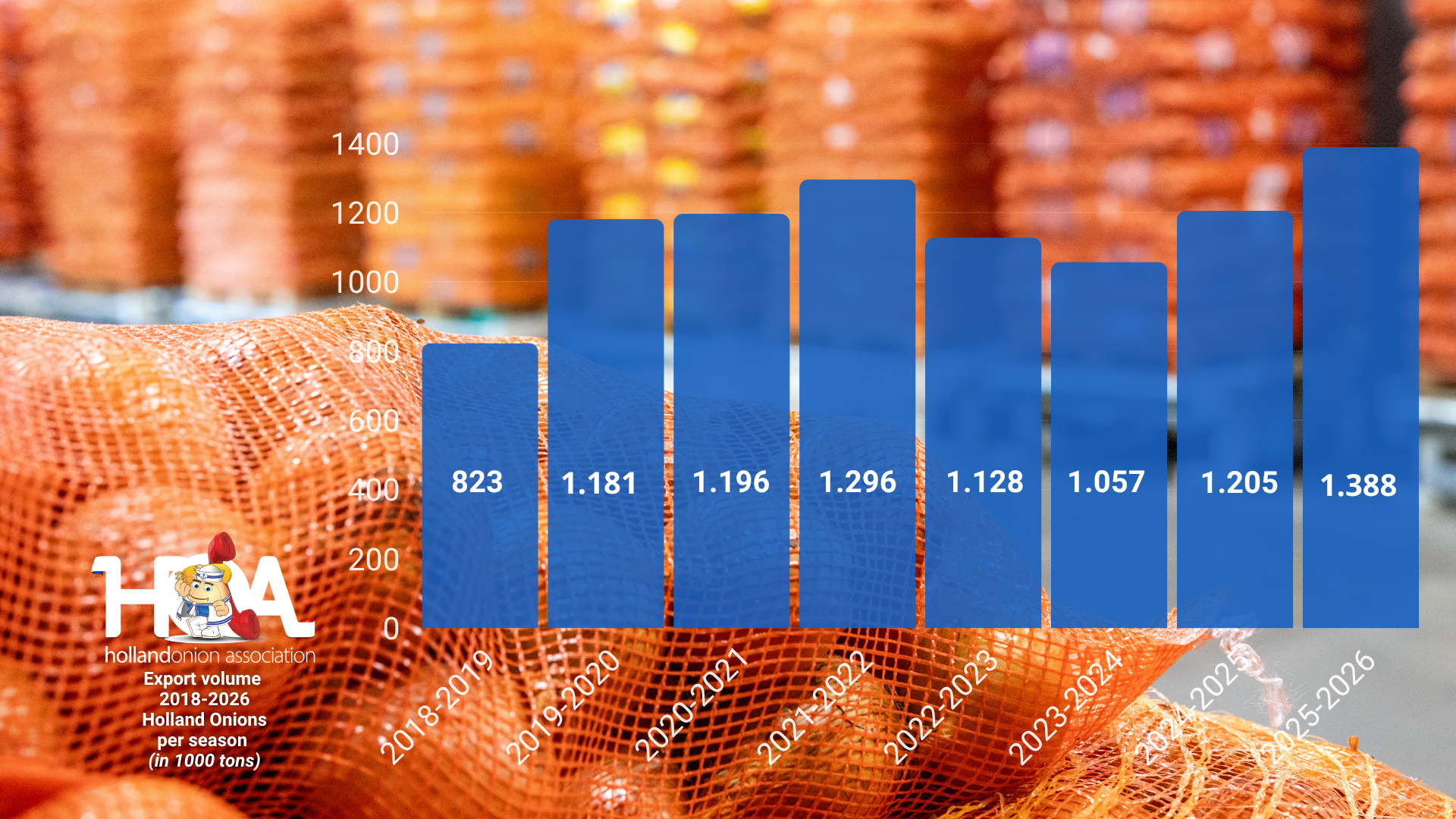
The final total reached 1,388,439 tonnes of Holland Onions. This not only set a new export record but also surpassed the previous record set in the 2021–2022 season by approximately 7 percent. Compared to the 2024–2025 season, the final export volume was about 15 percent higher.
To put that volume into perspective: assuming an average of seven to eight onions per kilogram, this amounts to approximately 10 billion onions—more than enough to keep everyone in the Netherlands supplied with onions year-round, with one Holland Onion still left for every person on Earth.
A steadily broadening global market
Africa remained by far the largest regional market for Dutch onions in the 2025–2026 season. By the end of the season, nearly 57 percent of total exports were destined for the African continent. Europe accounted for over 27 percent, the Americas for nearly 10 percent, and Asia (including the Middle East) for over 6 percent.However, the trends observed throughout the season are particularly interesting. Up to and including week 19, Africa’s share stood at over 64 percent, while Europe accounted for 24.6 percent and the Americas just 4.3 percent. The geographic spread of exports clearly broadened during the final months; although Africa remained the largest market by a wide margin, other continents gained relative ground.This record demonstrates more than just an exceptionally high total volume; it also highlights the Dutch onion sector’s ability to respond flexibly to demand across different international markets throughout the season. Senegal was once again the largest individual export destination, taking over 231,500 tonnes, followed by Ivory Coast with more than 212,000 tonnes. Great Britain ranked third. In total, Dutch onions found their way to more than 130 destinations worldwide.
Europe: over a quarter of total exports
Europe remained a key pillar of Dutch onion exports, accounting for approximately 27 percent of the total. In absolute terms, this amounted to around 377,000 tonnes.
However, this European total masks a highly varied picture. Great Britain was the standout performer. Exports to Great Britain reached nearly 162,000 tonnes of Dutch onions, an increase of approximately 48 percent compared to the previous season. Exports to Ireland also increased. Sales proved more challenging in various markets on the European mainland. Compared with the previous season, export volumes were down by approximately 7–9 percent in Germany, 48 percent in Belgium, and 27 percent in France.
These countries are becoming increasingly self-sufficient. Some growers in these countries now supply Dutch processors, taking advantage of the Netherlands’ established processing and logistics network. Consequently, growth was far from uniform across European markets. The combination of exceptionally strong British demand and growing sales outside Europe illustrates the broad international reach of the Dutch onion trade.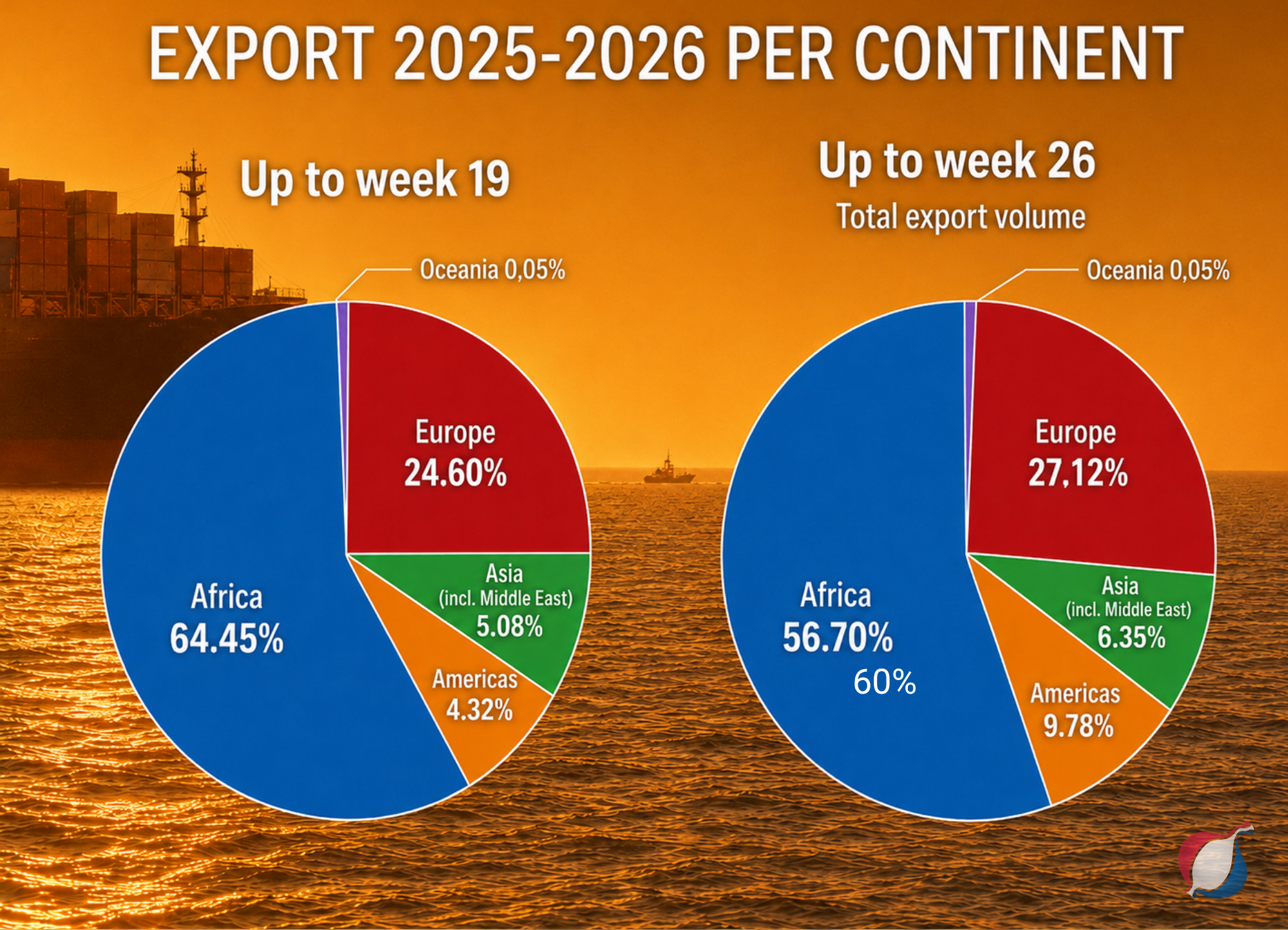
The Netherlands as an international onion hub
The Netherlands' international position is not limited to its domestic onion crop. According to export statistics, approximately 85,000 tonnes of foreign-grown onions were also traded and re-exported by Dutch companies during the same season.
This underscores the broader role the Netherlands plays in the global onion trade. Dutch cultivation forms the foundation of a highly specialized supply chain encompassing sorting, packaging, quality control, trading, and logistics. Retailers in some European markets specifically require Dutch-grown onions. Dutch companies have extensive international customer networks, alongside the expertise and infrastructure to efficiently move large volumes to a wide range of destinations.
Consequently, the Netherlands is not only one of the largest onion exporters but also an international hub within the global onion trade.
The export paradox
However, a record export volume does not automatically translate into record returns for growers. Indeed, export volumes and grower prices can sometimes move in almost opposite directions. The situation was virtually reversed during the 2018–2019 season. Dutch onion exports stalled at approximately 823,000 tonnes—the lowest level in years—while scarcity drove grower prices to exceptionally high levels. In 2025–2026, the picture was almost the reverse: abundant supply and low grower prices coincided with a record export volume of nearly 1.4 million tonnes.
This highlights the paradox of the past season. The relatively low price made the Holland Onion highly competitive on the global market, facilitating the sale of very large volumes.
However, while this strengthened the position of Dutch onions on international markets, it also meant disappointing financial returns for many Dutch onion growers. For them, what ultimately matters is not the total volume of Dutch exports, but what remains on the bottom line after cultivation, harvesting, and storage costs. Naturally, lower prices are not good news for the grower. However, from an international perspective, such a season can open new doors. New buyers become familiar with Dutch onions, existing customers can purchase larger volumes, and trade relationships can deepen. If these relationships endure, a season of low grower prices may nevertheless provide a broader foundation for future sales.
After a flying start
Even as the last onions from the 2025–2026 season were being exported, the new crop was already entering the market. Exports of the new crop gained momentum in week 27, and the start was nothing short of spectacular. According to subsequently revised figures, approximately 13,500 tonnes were exported that week—compared to around 6,900 tonnes during the same week the previous year. Exports were therefore almost twice as high as in the same week a year earlier. After three weeks, the percentage lead began to narrow, but export volumes themselves showed no signs of slowing down. By the end of week 29, the cumulative volume remained more than 60 percent above the level of the previous year, with total exports reaching over 48,000 tonnes. The pace then accelerated further: weekly volume rose from approximately 13,500 tonnes in week 27 to 34,871 tonnes in week 32. More strikingly, cumulative exports over the first six weeks reached an all-time high for that stage of a Dutch onion export season. Week 32 alone, at nearly 35,000 tonnes, was exceptionally strong for such an early point in the season. That exceptional lead did not hold in the weeks that followed. While exports through week 33 were still more than 12% ahead of last season, that advantage has now disappeared completely.
West Africa leads the way again
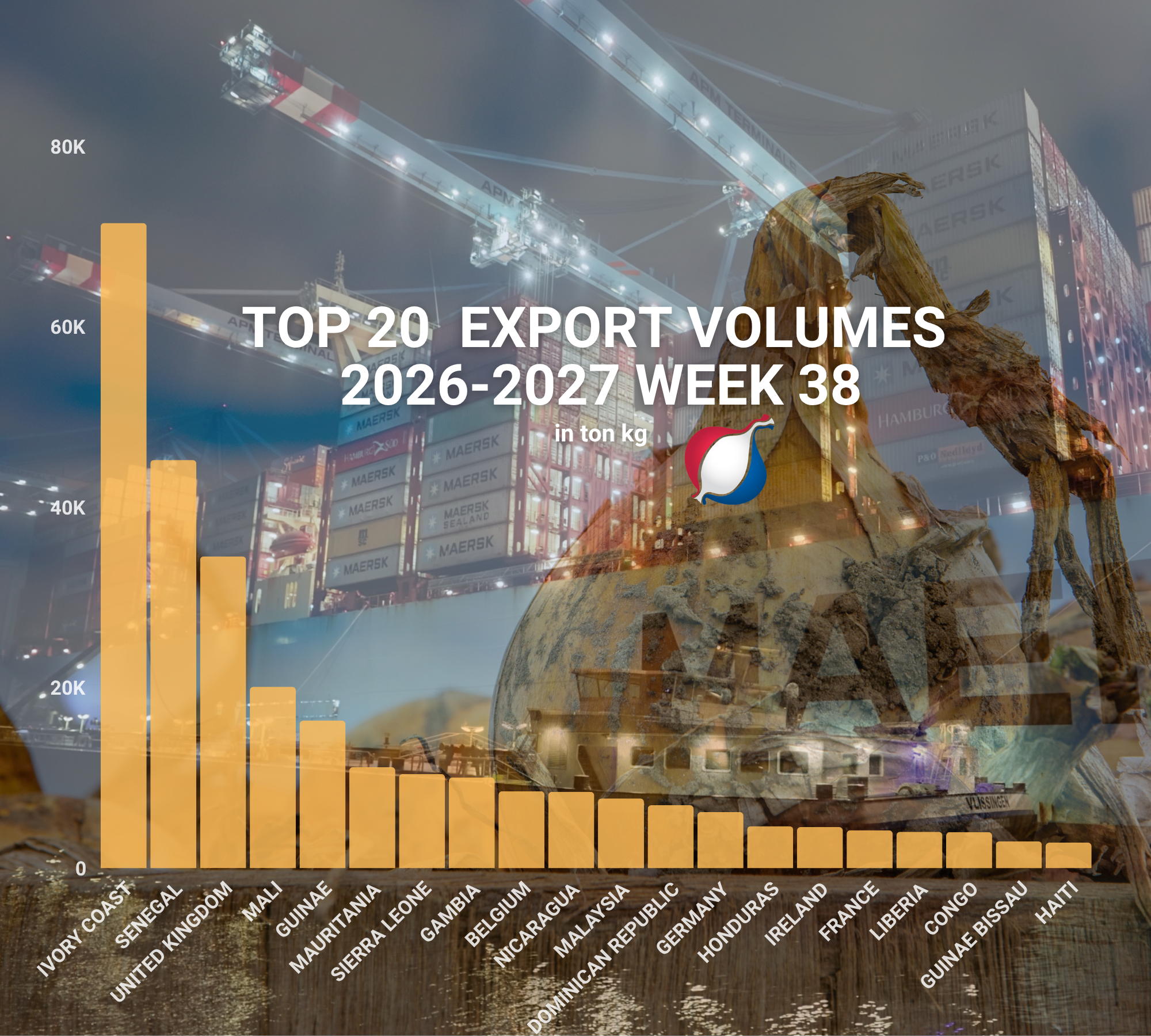
The new season shows just how quickly global trade flows can develop. Through week 38, more than 321,000 tons of Holland Onions have been exported, around 2% less than in the same period last season. West Africa continues to set much of the pace, accounting for more than 60% of total export volume in the first fifteen weeks.
With around 71,500 tons, Côte d’Ivoire is currently the largest individual destination, up more than 27% from the same period last season. Senegal follows with over 45,200 tons, but is down around 29%. Mali has now reached more than 20,000 tons, approximately 3% above last season. Developments within West Africa therefore vary considerably. Sierra Leone and Liberia continue to show strong growth, while Guinea and Mauritania, among others, remain well below last season’s levels. Overall, exports to West Africa are currently around 2% lower than a year ago.
Movement across the Americas
Beyond the familiar West African core, there is plenty of movement elsewhere as well. Exports to the Americas and the Caribbean have reached more than 37,000 tons through week 38, around 10% more than in the same period last season. Nicaragua remains the largest destination in the region at around 8,450 tons, approximately 13% above last season. Brazil is particularly notable: more than 2,400 tons were exported there in the past two weeks alone, bringing the season total to around 2,550 tons. Guatemala, Trinidad and Tobago, and Haiti are also showing growth, while the Dominican Republic, at almost 7,000 tons, is now roughly in line with last season.
Britannia rules
Great Britain continues to confirm its position as a particularly important European destination. At around 34,500 tons, it remains the third-largest individual export market. Volumes are currently around 6% above last season, allowing Great Britain to maintain the strong position it established during the previous record season. It is, of course, far too early to draw conclusions about the entire 2026–2027 season based on the first fifteen weeks.
Early exports consisted largely of relatively large set-grown onions. Seed-grown onions are now increasingly entering the export market. Persistent drought is expected to affect both their yields and bulb sizes, resulting in marked differences compared with the set-grown crop. The growing season thus once again highlights the critical importance of access to sufficient fresh water. Moreover, export figures are subject to subsequent updates and corrections. What this initial phase of the season clearly demonstrates is how quickly the situation can change. While cumulative exports through week 33 were still more than 12% ahead of last season, five weeks later they are around 2% lower.
The 2025–2026 season concluded with a historic record. The 2026–2027 season began with an exceptional surge in activity but has since entered a new phase. Behind the near-identical year-over-year cumulative totals, trends vary widely by market: exports to Ivory Coast are rising, shipments to Senegal are declining, trade with the Americas is growing, and Great Britain is holding its position. Above all, the new season illustrates just how quickly global trade patterns can change.